


Buddha Purnima 2027 date and the meaning of Vesak
Buddha Purnima 2027 is on Thursday 20 May, a gazetted holiday. What Vesak marks, how it is observed at Bodh Gaya and Sarnath, and how to plan a long weekend.

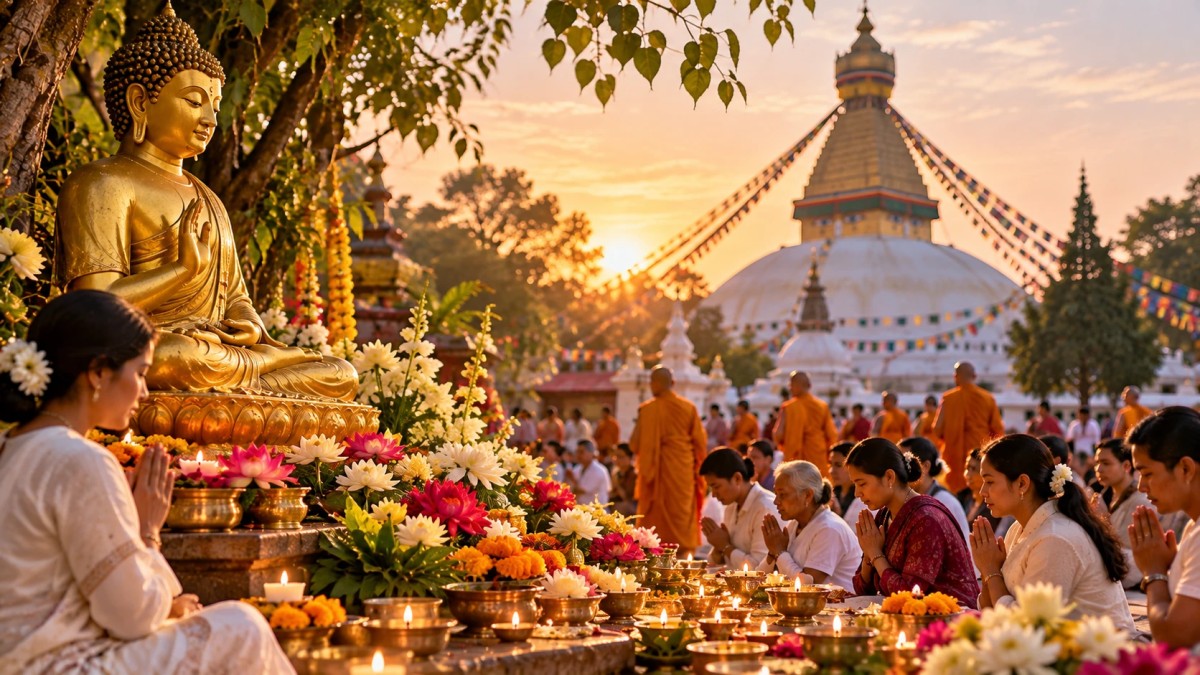
Buddha Purnima 2027, also called Buddha Jayanti or Vesak, falls on Thursday, 20 May 2027. It is a gazetted holiday on the Union government's list for 2027 and falls on the full moon of the month of Vaishakha.
For Buddhists, this single full-moon day marks the three most important events in the life of Gautama Buddha: his birth, his enlightenment and his passing into nirvana. Here is what the day means and how it is observed in India.
Key points
- Buddha Purnima 2027: Thursday 20 May (gazetted holiday).
- It falls on Vaishakha Purnima, the full moon of the month of Vaishakha.
- It marks the Buddha's birth, enlightenment and mahaparinirvana.
- The biggest celebrations in India are at Bodh Gaya, Sarnath and Kushinagar.
- Taking Friday 21 May off gives a four-day weekend from 20 to 23 May.
Buddha Purnima 2027 at a glance
| Detail | 2027 |
|---|---|
| Date | Thursday 20 May 2027 |
| Tithi | Vaishakha Shukla Purnima (full moon) |
| Holiday status | Gazetted holiday for central government offices |
| Also called | Buddha Jayanti, Vesak, Vaishakha Purnima |
Some Buddhist countries, such as Sri Lanka, Myanmar and Thailand, calculate Vesak by their own calendars and may mark it on a different day from India. In India, the official date is 20 May.
Who was the Buddha
Siddhartha Gautama was born a prince of the Shakya clan at Lumbini, in present-day Nepal, around the 6th or 5th century BCE. Moved by the suffering he saw in the world, he left his palace, family and comforts to search for the end of suffering.
After years of meditation and severe austerity, he attained enlightenment (bodhi) under a peepal tree at Bodh Gaya, in present-day Bihar, and became the Buddha, "the awakened one". He gave his first sermon at Sarnath, near Varanasi, and taught across north India for about 45 years. He died, or entered mahaparinirvana, at Kushinagar, in present-day Uttar Pradesh.
In the Theravada tradition, followed in Sri Lanka and much of South East Asia, all three events, the birth, the enlightenment and the death, are believed to have taken place on the full moon of Vaishakha, which is why Buddha Purnima marks all of them.
The Bodhi tree
The tree at Bodh Gaya has a remarkable history. According to tradition, the emperor Ashoka's daughter Sanghamitta carried a sapling of the original tree to Sri Lanka in the 3rd century BCE, where it was planted at Anuradhapura and still grows, one of the oldest recorded trees in the world. The original tree at Bodh Gaya was later destroyed, and the tree that stands there today is believed to have grown from a cutting of the Sri Lankan tree, bringing the line back to where it began. Pilgrims tie prayer cloths to its railing and sit in meditation beneath it.
The teachings in brief
The Buddha's teaching centres on the Four Noble Truths: that life involves suffering, that suffering has a cause (craving and attachment), that suffering can end, and that there is a path to its end, the Noble Eightfold Path of right view, intention, speech, action, livelihood, effort, mindfulness and concentration. He taught the Middle Way, between indulgence and extreme self-denial, and non-violence and compassion towards all living beings.
How Buddha Purnima is observed
- Visiting viharas and stupas: Buddhists visit monasteries and temples, offer flowers, incense and candles, and listen to sermons.
- Observing the precepts: Many people take the Eight Precepts for the day, eating simply and avoiding entertainment.
- Dana (giving): Charity, food for monks and meals for the poor are central. Kheer (rice pudding) is often offered and shared, remembering Sujata, a village woman who offered rice and milk to the Buddha before his enlightenment.
- Meditation and chanting: Monasteries hold group meditation and recite sutras.
- Bathing the Buddha: In some traditions, devotees pour water over a small statue of the infant Buddha.
- Lighting lamps: Homes, temples and stupas are lit in the evening.
Releasing caged birds and animals, once a popular custom, is now discouraged by many Buddhist organisations because of harm to the animals; many people give to animal welfare instead.
Where to observe Buddha Purnima in India
- Bodh Gaya (Bihar): The Mahabodhi Temple, a UNESCO World Heritage Site, and the Bodhi tree, a descendant of the tree under which the Buddha attained enlightenment, draw pilgrims from across Asia.
- Sarnath (Uttar Pradesh): The Dhamek Stupa marks the site of the first sermon, and processions and prayers are held here.
- Kushinagar (Uttar Pradesh): The Mahaparinirvana Temple, with its reclining Buddha, marks the place of the Buddha's passing.
- Sanchi (Madhya Pradesh): The great stupa, another UNESCO World Heritage Site.
- Ladakh, Sikkim, Arunachal Pradesh and Himachal Pradesh: Monasteries in the Himalayan regions hold prayers and festivals. In Sikkim the day is known as Saga Dawa.
- Nagpur (Maharashtra): Deekshabhoomi, where Dr B.R. Ambedkar and hundreds of thousands of his followers embraced Buddhism in 1956, is a major centre for India's Ambedkarite Buddhists.
The Buddhist pilgrimage circuit
Buddhist tradition names eight great places linked to the Buddha's life, seven of them in India: Bodh Gaya, Sarnath, Kushinagar, Rajgir and Vaishali in Bihar and Uttar Pradesh, Sravasti and Sankassa in Uttar Pradesh, and Lumbini, just across the border in Nepal. Many pilgrims from Sri Lanka, Thailand, Myanmar, Japan, Vietnam and Korea visit several of them in one journey, and IRCTC has run special Buddhist Circuit tourist trains connecting the main sites.
Temple etiquette: Dress modestly, covering shoulders and knees, remove your shoes before entering shrines, walk around stupas clockwise, and ask before photographing monks or ceremonies.
Buddhism in India today
According to the 2011 Census, India has about 84 lakh Buddhists, around 0.7% of the population, with the largest numbers in Maharashtra, followed by West Bengal and Madhya Pradesh. Many are followers of the movement led by Dr Ambedkar, while the Himalayan states have long-standing Tibetan Buddhist communities. India is also home to the Dalai Lama and the Tibetan community in exile in Dharamshala.
Vesak around the world
The United Nations recognises the Day of Vesak as an international day of observance. In Sri Lanka, Vesak is marked with thousands of lanterns and pandals that tell stories from the Buddha's life, and free food stalls (dansal) along the roads. Nepal celebrates at Lumbini, the Buddha's birthplace.
Planning for Buddha Purnima 2027
- A four-day weekend: Buddha Purnima is on Thursday 20 May. Taking Friday 21 May off gives a break from Thursday to Sunday, 20 to 23 May. Bakrid, expected on Monday 17 May, comes in the same week.
- Heat: Bodh Gaya, Sarnath and Kushinagar are very hot in May. Visit early in the morning or after sunset, carry water and dress modestly for temples.
- Accommodation: Bodh Gaya fills up for Buddha Purnima; book early.
See our long weekends 2027 guide and the full festival calendar for 2027.
On the full moon of 20 May 2027, lamps will be lit at Bodh Gaya, Sarnath and Kushinagar, as they have been for centuries. Whether you visit a stupa or spend the day quietly, it is a day for compassion and reflection.
Frequently asked questions
What's Your Reaction?
 Like
0
 Dislike
0
 Love
0
 Funny
0
 Wow
0
 Sad
0
 Angry
0





Comments (0)