


Janmashtami 2027 date and midnight puja time
Janmashtami 2027 is on Wednesday 25 August by most panchangs and the government list, with the midnight puja around 12:01 AM. Why some calendars say 24 August.

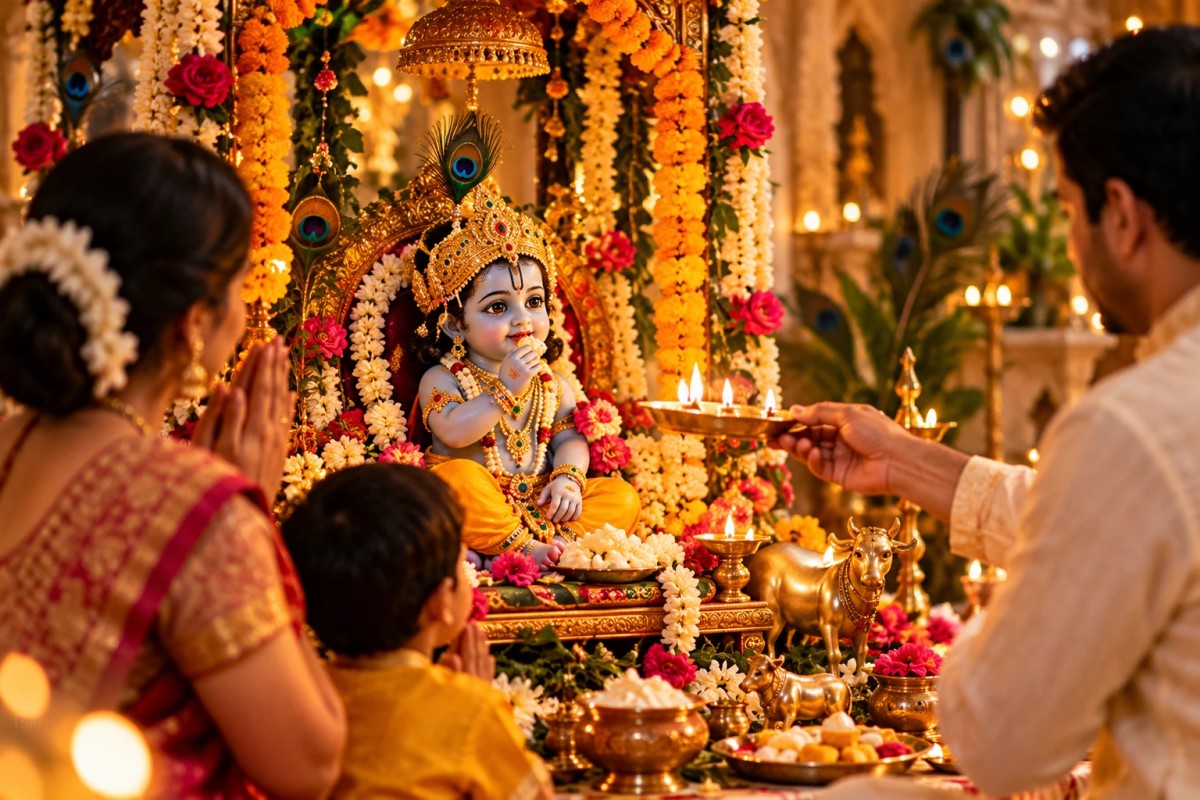
Krishna Janmashtami 2027 falls on Wednesday, 25 August, according to most Hindu almanacs (panchangs) and the Union government's holiday list for 2027. The midnight puja, marking the hour of Lord Krishna's birth, falls at about 12:01 AM to 12:45 AM on the night of 25 to 26 August in Delhi.
A few panchangs give Tuesday, 24 August. Here is why, and how to plan.
Key points
- Janmashtami 2027: Wednesday 25 August (most panchangs; gazetted holiday).
- Some panchangs mark it on Tuesday 24 August.
- Nishita (midnight) puja in Delhi: about 12:01 AM to 12:45 AM, night of 25 to 26 August.
- Dahi Handi and Nandotsav: Thursday 26 August, the day after Janmashtami.
- Janmashtami comes eight days after Raksha Bandhan, which is on 17 August.
Janmashtami 2027 date and time
| Detail | Time (New Delhi) |
|---|---|
| Janmashtami | Wednesday 25 August 2027 |
| Nishita puja (midnight) | About 12:01 AM to 12:45 AM, night of 25 to 26 August |
| Rohini nakshatra | About 12:27 PM on 25 August to 11:42 AM on 26 August, according to one panchang |
| Dahi Handi, Nandotsav | Thursday 26 August |
| Government holiday | Wednesday 25 August (gazetted) |
Timings differ by a few minutes from city to city. Mumbai-area panchangs, for example, put the midnight window slightly later.
Why do some calendars say 24 August?
Janmashtami is celebrated on the eighth day (Ashtami) of the dark half of the month of Bhadrapada, at midnight, the hour Krishna is believed to have been born. Two factors decide the day: whether the Ashtami tithi is in effect at midnight, and, for some traditions, whether the Rohini nakshatra (Krishna's birth star) is also present.
Because the Ashtami tithi does not begin and end at midnight, different almanacs reach different answers. In 2027, most panchangs that follow the Smarta rule (the night when Ashtami is present at midnight) place Janmashtami on 25 August. A smaller number, using different references, place it on 24 August.
Vaishnav communities, including many temples in Mathura, Vrindavan and ISKCON centres, sometimes celebrate on a different day from the rest of the country. If you plan to visit a particular temple, check its own calendar.
The story of Krishna's birth
Krishna was born in a prison cell in Mathura, to Devaki and Vasudeva, on a stormy midnight. Devaki's brother, the tyrant king Kansa, had been warned that her eighth son would kill him, and had imprisoned the couple and killed their earlier children.
On the night of Krishna's birth, the story goes, the guards fell asleep, the prison doors opened, and Vasudeva carried the baby across the flooded Yamuna to Gokul, where he was raised by Nanda and Yashoda. Krishna grew up to defeat Kansa and became the central figure of the Mahabharata and the Bhagavad Gita.
How Janmashtami is celebrated
- Fasting: Many devotees fast through the day and break the fast after the midnight puja. Some keep a fast without grains, eating fruit and milk.
- Midnight puja: At midnight, an idol of baby Krishna is bathed in milk, curd, honey and ghee (abhishek), dressed and placed in a decorated cradle. Bells, conch shells and bhajans mark the moment of birth.
- Jhankis: Temples and homes set up tableaux showing scenes from Krishna's life.
- Food: Panjiri, makhana kheer, butter and mishri (the offering called makhan-mishri) and sweets made with milk.
- Rasa lila: Dramatic performances of Krishna's childhood and youth, especially in Braj.
Dahi Handi 2027
On the day after Janmashtami, Thursday 26 August 2027, Maharashtra and Goa celebrate Dahi Handi. Teams of young men and women called govindas form human pyramids to reach and break a clay pot of curd hung high above the street, recreating Krishna's childhood love of stealing butter. Mumbai and Thane see the biggest celebrations, with prize money for the teams that reach the highest pots.
In north India, the same day is celebrated as Nandotsav, the festival of Nanda, Krishna's foster father, marking the joy in Gokul at Krishna's arrival.
Safety: Human pyramids carry real risk of serious injury. Maharashtra has set rules for Dahi Handi over the years, including on the age of participants and safety gear, and organisers are expected to follow them.
Janmashtami fast, what people eat
Fasting rules vary by family. Some devotees keep a nirjala fast, without food or water, until midnight. Most keep a phalahar fast, avoiding grains, onion and garlic, and eating fruit, milk, curd, makhana (fox nuts), sabudana and dishes made with singhara (water chestnut) or kuttu (buckwheat) flour.
The fast is traditionally broken after the midnight puja with the prasad offered to Krishna, often panjiri (roasted wheat flour with ghee, sugar and dry fruit), makhan-mishri and panchamrit, a mix of milk, curd, honey, ghee and sugar. Anyone who is pregnant, elderly or on regular medicine should check with a doctor before a strict fast.
Where to celebrate Janmashtami
- Mathura and Vrindavan: The birthplace of Krishna sees huge crowds at the Krishna Janmabhoomi temple and at the Banke Bihari temple in Vrindavan. Expect very heavy crowds; plan transport in advance and follow the police advisories.
- Dwarka (Gujarat): The Dwarkadhish temple is the other major centre, drawing pilgrims from across Gujarat.
- ISKCON temples: In cities across India and abroad, ISKCON temples hold all-night celebrations.
- Puri (Odisha) and Udupi (Karnataka): Both have their own Krishna traditions, with Udupi celebrating as Krishna Jayanti.
Janmashtami across India
The festival has different names in different regions: Gokulashtami in Maharashtra and parts of the south, Krishnashtami or Sri Jayanti in Kerala and Karnataka, and Janmashtami across the north. In Tamil Nadu, families draw tiny footprints with rice-flour paste from the doorway to the puja room, as if baby Krishna has walked into the home.
Janmashtami 2027 for Indians abroad
Hindu temples and ISKCON centres in the US, UK, Canada, Australia, Singapore and the Gulf hold midnight celebrations, often with live streams for families who cannot attend. Because of time-zone differences, temples abroad set their own date and midnight time, which may not match India's. Check your local temple's calendar before planning your fast.
Planning for Janmashtami 2027
- Holiday: Janmashtami on Wednesday 25 August is a gazetted holiday for central government offices in Delhi, and a holiday in most states.
- A busy August: Independence Day falls on Sunday 15 August and Raksha Bandhan on Tuesday 17 August, so many people will take leave in the second half of the month.
- Mathura travel: Book trains and hotels early, and check whether your temple visit falls on the 24th or 25th. Rooms in Mathura and Vrindavan sell out weeks ahead of the festival.
See every festival of the year in our full festival calendar for 2027, and our Raksha Bandhan 2027 guide.
On the night of 25 August 2027, temples across India will ring their bells at midnight to welcome Krishna. Check your local panchang for the exact time, and plan ahead if you are heading to Mathura or Vrindavan.
Frequently asked questions
What's Your Reaction?
 Like
0
 Dislike
0
 Love
0
 Funny
0
 Wow
0
 Sad
0
 Angry
0




Comments (0)