


What the Riyadh airport shutdown means for Indian flyers
Houthi strikes have kept Riyadh's main airport shut since 10 Oct, and Indian airlines have cancelled Saudi flights into next week. What Indians need to know.

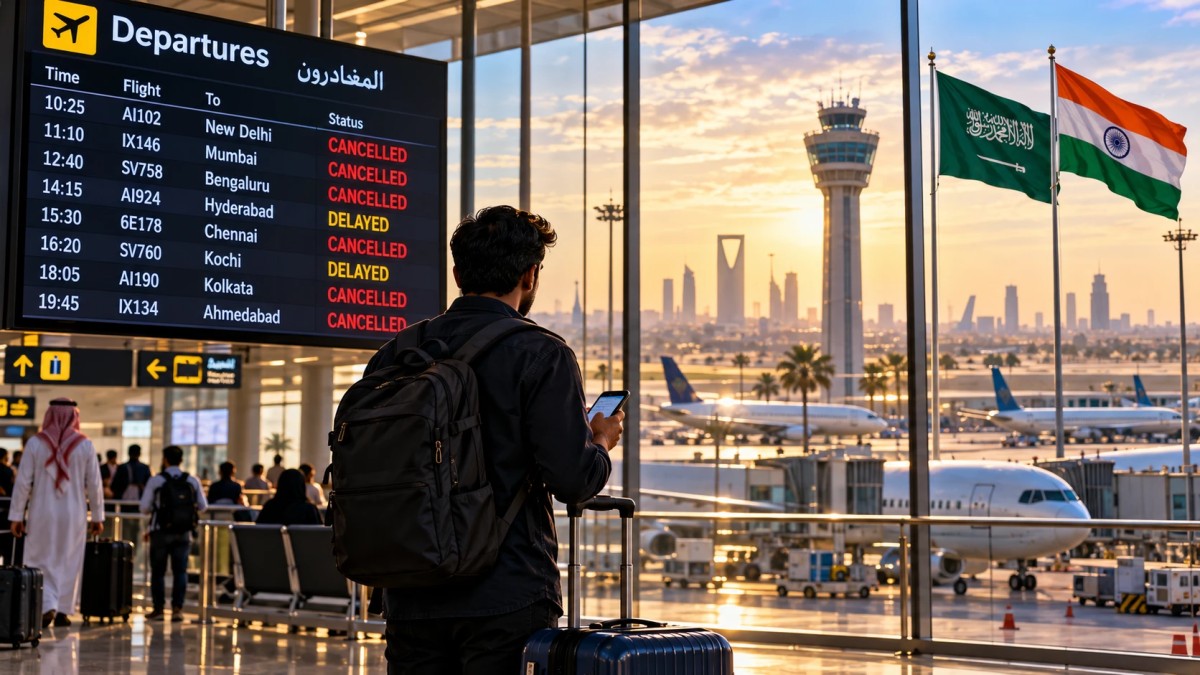
Updated 18 Oct 2026, 7:45 PM IST: Riyadh's King Khalid International Airport reopened on Sunday, 18 October, The National reported. Air India and Air India Express have kept Riyadh, Jeddah and Dammam flights suspended until 24 October; IndiGo has cancelled Riyadh, Jeddah, Dammam and Madinah flights up to 24 October; Akasa Air's Riyadh flights are suspended until 24 October and Jeddah until 21 October. Check with your airline before travelling.
Riyadh's main airport has been closed to flights since a Houthi missile strike on 10 October 2026, and Indian airlines aren't planning to fly there again until next week at the earliest. Air India has cancelled its Riyadh, Dammam and Jeddah flights until 20 October; IndiGo and Akasa Air have cancelled some Saudi routes until 24 October.
If you're booked on one of those flights, you're entitled to a refund or a free change, the airlines say. If you live in Saudi Arabia, the Indian Embassy's advice is to plan for disruption.
Key points
- King Khalid International Airport in Riyadh has been shut since a ballistic missile hit its Terminals 3 and 4 on 10 October. A closure notice ran until 21:00 UTC on 17 October (2:30 AM IST on 18 October), with no reopening date announced.
- An Indian man from Hyderabad was among those killed in the 10 October strike; the Indian Embassy in Riyadh said he died of his wounds.
- Air India and Air India Express: Riyadh, Dammam and Jeddah cancelled until 20 October. IndiGo: Riyadh, Jeddah, Dammam and Madinah until 24 October. Akasa: Riyadh until 24 October, Jeddah until 21 October.
- About 2.75 million Indians live in Saudi Arabia, the largest group of non-resident Indians in any country, according to India's Ministry of External Affairs.
What happened at Riyadh airport
The airport closed after the worst of a series of attacks by Yemen's Houthi movement on Saudi airports between 6 and 12 October. On 10 October a ballistic missile struck a complex containing Terminals 3 and 4 at King Khalid International. Saudi authorities said 12 people were killed in the first count and more than 300 injured.
They didn't stop there. Terminal 4 was hit again on 11 October, starting a fire, and a Pakistani resident died. On 12 October Saudi Arabia said it intercepted three ballistic missiles, one of them aimed at Riyadh. The Saudi-led coalition says the Houthis have launched 20 attacks on the airport since 1 October.
Abha airport in the south-west was hit on 6 and 7 October, and King Fahd International in Dammam on 11 October, without casualties reported in Dammam.
The Houthis, who control much of northern Yemen including the capital Sanaa, say the strikes are retaliation for Saudi air strikes on civilian sites in Yemen. Their fight with Saudi Arabia reignited after a Saudi strike on Sanaa airport on 13 July 2026, after which the group ended the 2022 truce brokered by the United Nations. UN Secretary-General António Guterres condemned the airport attack; UN envoy Hans Grundberg called it a grave escalation.
The Indian killed, and the families caught up
An Indian citizen wounded in the 10 October strike later died in hospital, the Indian Embassy in Riyadh said. Arab News identified him as Mohammad Yousuf Ali, an IT engineer from Hyderabad who worked between Saudi Arabia and India. He'd come with his family on their first Umrah together, the minor pilgrimage to Mecca that Muslims can make at any time of year.
According to Arab News, two of his sons were still in hospital this week, one of them with severe injuries that needed several operations. Other relatives had lighter injuries and have been discharged.
India's Ministry of External Affairs condemned the strikes on 11 October, calling repeated attacks on civilians and civilian infrastructure unacceptable and saying they must stop immediately, ThePrint and Deccan Herald reported. It offered condolences to the families of those killed and had issued an earlier statement on 8 October after the attacks on Abha and Riyadh. Eleven Indians were among the more than 300 people injured on 10 October, Onmanorama reported.
Riyadh airport closed: Indian flights cancelled, and until when
Here's where things stood on 17 October, based on airline statements reported by ANI and travel trackers. Always check your airline's own site before going to the airport, because these dates have already moved more than once.
| Airline | Routes cancelled | Until | What you can do |
|---|---|---|---|
| Air India | Riyadh, Dammam, Jeddah | 20 October | Full refund, or rebooking where offered |
| Air India Express | Riyadh, Dammam, Jeddah | 20 October | Free reschedule or full refund |
| IndiGo | Riyadh, Jeddah, Dammam, Madinah | 24 October (inclusive) | Check IndiGo's site for refund or change |
| Akasa Air | Riyadh; Jeddah | 24 October; 21 October | Refund within seven days or a free change |
Air India said on 16 October that it is watching the situation before deciding when services can safely resume, ANI reported.
Some flights are still running between India and Saudi cities other than Riyadh. Saudia is flying to India from Dammam, Jeddah and Madinah, and the low-cost carriers flynas and flyadeal have kept some Dammam flights to Lucknow and Mumbai, according to the aviation site AeroCorner. Gulf carriers have their own cancellations: Etihad, for example, has cancelled Riyadh flights until 19 October.
A closure notice ending doesn't mean the airport reopens that minute. As of Saturday morning in Riyadh, the General Authority of Civil Aviation (GACA) had not said when flights would resume, and the closure has already been extended at least twice. GACA has said the suspension continues while safety and readiness checks are completed.
What Indians in Saudi Arabia are being told
The Indian Embassy in Riyadh told Indian nationals on 16 October to allow for travel disruption. For those who must leave urgently, it suggested routing through Bahrain, Kuwait or Qatar, where their visas allow it, AeroCorner reported.
The embassy posts its helpline numbers and latest advisories on its website, eoiriyadh.gov.in, and on its X account.
Other governments have gone further. Australia moved Saudi Arabia to "do not travel" on 16 October. The United States keeps the country at Level 3, "reconsider travel". The UK has told its citizens to stay away from King Khalid airport until it is secure.
India hadn't issued a "do not travel" advisory as of 17 October. That matters for the steady stream of Indians who fly to Saudi Arabia for work, for family visits and for Umrah, many of them on tickets booked months ago.
Why it matters: Saudi Arabia is home to more Indians than any other foreign country, and the money they send home supports families across Kerala, Telangana, Uttar Pradesh, Bihar and beyond. For readers outside India, this is a reminder that a war in Yemen reaches Indian homes quickly: through a closed airport, a cancelled flight home, or a family's pilgrimage that ended in hospital.
The wider risks for India
The direct risk is to people. The second is to fuel prices. Brent crude has been trading above $100 a barrel, and the Reserve Bank of India cited crude oil volatility and geopolitical tensions when it raised interest rates on 7 October. India buys most of its crude oil abroad, much of it from the Gulf, so a longer Saudi–Houthi conflict could keep pressure on petrol, diesel and cooking gas prices.
There's also the pilgrim traffic. The Houthis have warned airlines against using Saudi airports, except those serving Mecca and Madinah. Jeddah, the main gateway for Umrah, was open but facing delays and cancellations, according to a US Embassy alert of 16 October. IndiGo has still suspended its Madinah flights until 24 October.
Iran has offered to mediate. US President Donald Trump called the attack unacceptable and said a decision on further action was pending. None of that has yet put a date on Riyadh's reopening.
For the family from Hyderabad, none of the airline dates matter much now. For everyone else with a ticket to Riyadh, the honest answer is that nobody, including the airlines, knows yet when normal flights will return.
Frequently asked questions
What's Your Reaction?
 Like
0
 Dislike
0
 Love
0
 Funny
0
 Wow
0
 Sad
0
 Angry
0





Comments (0)