


SIR protests reach Jantar Mantar, rival rallies in London
Protests over India's voter roll revision reached a third week on 17 Oct with a Jantar Mantar march in Delhi and rival rallies in London. What each side says.

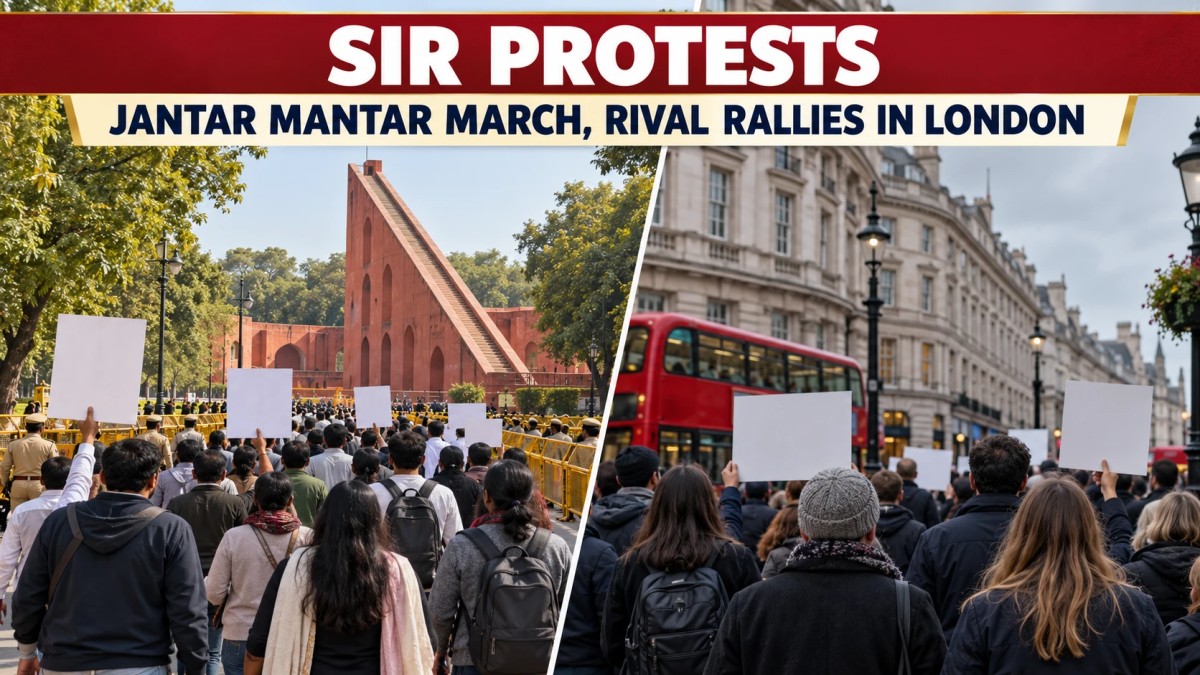
Protests against the Election Commission's revision of India's voter rolls entered a third week on Saturday, 17 October 2026, with a march in New Delhi to demand that Jantar Mantar be restored as a protest site, and rival demonstrations in London. Delhi Police detained several marchers, news agency IANS reported.
At the centre of the dispute is the Special Intensive Revision (SIR), a house-to-house check of voter lists that has removed more than 13 crore (130 million) names from draft rolls across phases. Protesters want it withdrawn and the Chief Election Commissioner, Gyanesh Kumar, to resign. The Election Commission says the exercise is meant to keep every eligible voter on the rolls and remove only ineligible entries.
Key points
- The "Reclaim Jantar Mantar" march on 17 October followed the Union government's decision on 12 October to drop Jantar Mantar, near Parliament, from Delhi's designated protest sites.
- Protests began with a sit-in against the Chief Election Commissioner on 2 October. Around 2,000 to 2,500 people were detained in Delhi on 10 October, according to figures cited by Reuters and The Hindu.
- The Election Commission and the BJP deny wrongdoing. The Supreme Court upheld the SIR in May 2026.
- In London, crowds for and against the protests gathered at Parliament Square on 17 October, a day after a counter-rally outside the Indian High Commission.
What happened on 17 October
Marchers set out toward Jantar Mantar, the historic protest venue a short walk from Parliament, demanding that it be restored as a designated site and that the SIR be withdrawn. Barricades blocked the approach roads and police were posted at key junctions, IANS reported. Several protesters were detained.
"Even if we are detained or face a cane charge, we will not stop," one protester told IANS. Another said the government had been "continuously detaining people who step out onto the streets".
The government has listed three alternative sites: Ramlila Ground, Burari Ground and the CBD Ground in East Delhi. Protest groups say these are too far from the city centre.
Jantar Mantar carries weight beyond its location. The name comes from the 18th-century astronomical observatory built there by Maharaja Jai Singh II of Jaipur, and the road beside it has been Delhi's best-known protest venue for decades, used by farmers' unions, anti-corruption campaigners, ex-servicemen and parties of every colour. Its status has been fought over before. On 23 July 2018, ruling on a petition by the Mazdoor Kisan Shakti Sangathan, a bench of Justices A.K. Sikri and Ashok Bhushan held that there could not be a complete ban on protests at Jantar Mantar and the Boat Club near India Gate, and asked Delhi Police to frame guidelines to balance the right to protest with residents' concerns.
SIR protest: who is protesting, and what they want
The protests are led by a mix of opposition parties and youth groups. The most visible is the Cockroach Janta Party (CJP), a youth movement with a deliberately satirical name, founded by Abhijeet Dipke. The Congress, its student wing NSUI and the Left-backed All India Students' Association (AISA) have also mobilised.
Their demands are the same across groups: withdraw the SIR and replace the Chief Election Commissioner. Congress leader Rahul Gandhi has backed the call for Kumar's resignation.
The movement's leaders have faced arrests. Dipke and two colleagues were detained when their flight from Mumbai landed in Delhi on 10 October and were released the next day by an executive magistrate on the condition of no breach of peace for a year, CJP lawyer Ratna Singh told Al Jazeera. On 14 October, CJP leaders Saurav Das and Ashutosh Ranka were arrested after entering Jantar Mantar and sent to five days of judicial custody on charges including trespass; a third, Ajinkya Shinde, was released on a bail bond.
What the government, the BJP and the Election Commission say
According to the Election Commission, the draft roll and its corrections process are meant to include every eligible voter. Anyone left out by mistake can apply for inclusion through the claims and objections process using Form 6. The commission hasn't responded to the resignation demand, and Kumar hasn't commented personally.
After The Indian Express reported that Election Commissioners Sukhbir Singh Sandhu and Vivek Joshi had raised objections on several occasions, the commission said "differing views are a normal part of deliberation in any institution" and that all SIR decisions were unanimous.
BJP spokesperson Sambit Patra called the 10 October demonstrators "anarchic elements" and said India "is calm and going ahead under good governance", Al Jazeera reported. Home Minister Amit Shah has said the allegation that the SIR disenfranchises voters comes from people who couldn't win elections, according to NPR.
India's mission to the United Nations in Geneva described international concerns as "misplaced" and said the right to peaceful assembly is guaranteed, subject to reasonable restrictions for public order.
We found no public response from the commission to the protesters' latest allegations as of 17 October.
What the opposition and critics say
Congress president Mallikarjun Kharge accused the government of turning India into a "Muzzled Democracy" after the 10 October detentions, which were reported to include opposition MPs and several former chief ministers. Critics of the SIR say the paperwork falls hardest on migrant workers, elderly voters and poor families without old records.
International voices have weighed in. A UN human rights spokesperson urged Indian authorities to respect the right to peaceful assembly. In Washington, US Congresswoman Pramila Jayapal said she was "deeply concerned" about the deletions; India's Ambassador to the US, Vinay Mohan Kwatra, called her remarks "unacceptable interference in India's internal affairs".
Why it matters: India had nearly 97 crore (970 million) registered voters at the 2024 general election, and who stays on the roll decides who can vote in the next state and national elections. For readers abroad, this is a dispute about how the world's largest democracy checks its voter lists, and how much protest its capital will allow while it does.
What is the SIR, briefly
The SIR is a re-verification of every name on the voter roll, carried out by booth-level officers who visit homes and collect forms. Its stated aim is to remove dead, shifted, duplicate and non-citizen voters. Bihar went first in mid-2025, a second phase covered nine states and three union territories, and the third phase, announced in May 2026, covers most of the rest.
Removals from draft rolls total about 7.2 crore in the first two phases and 6.16 crore so far in the third, according to reported Election Commission figures. Draft deletions can still be reversed through claims and objections.
The Supreme Court upheld the exercise in a May 2026 judgment, while ordering the commission to publish the names it deleted and to give anyone suspected of not being a citizen a fair hearing.
The London rallies
Abroad, the row has followed the diaspora. On Friday, 16 October, members of the Indian community in London held a counter-protest backing Prime Minister Narendra Modi outside the Indian High Commission, where NSUI and allied groups were protesting, The Tribune reported. On Saturday, crowds gathered at Parliament Square, split between supporters and opponents of the Election Commission and the CJP.
Both sides in this dispute say they're defending the vote. The next test is practical, not rhetorical: how many people who were left off the draft rolls get back on before the final lists are published.
Frequently asked questions
What's Your Reaction?
 Like
0
 Dislike
0
 Love
0
 Funny
0
 Wow
0
 Sad
0
 Angry
0



Comments (0)